Back to Blog

    Moringa Farming in Africa: Complete Guide to Production, Processing & Marketing

    A practical, farmer-friendly guide to growing, harvesting, processing, and selling moringa — the 'tree of life' transforming nutrition and incomes across Africa.
    Farm to the World Team
    Moringa Farming in Africa: Complete Guide to Production, Processing & Marketing

    This article is adapted with credit from Production and processing of moringa by Irénée Modeste Bidima, published in the Pro-Agro Collection (CTA & Engineers Without Borders Cameroon, 2016). Learn more about the author → Farm to the World shares this knowledge to empower African agripreneurs.

    Known as the "tree of life", moringa (Moringa oleifera Lam.) is one of the most versatile crops an African smallholder can grow. Its leaves, flowers, pods, seeds, bark, and roots are all useful — for food, medicine, water purification, cosmetics, and high-value oil. Drought-tolerant, fast-growing, and thriving across almost every tropical region, moringa is a serious business opportunity for youth and women in agribusiness.

    This guide condenses the core agronomy, post-harvest, and marketing know-how every moringa farmer in Africa should master.

    1. The Moringa Plant at a Glance

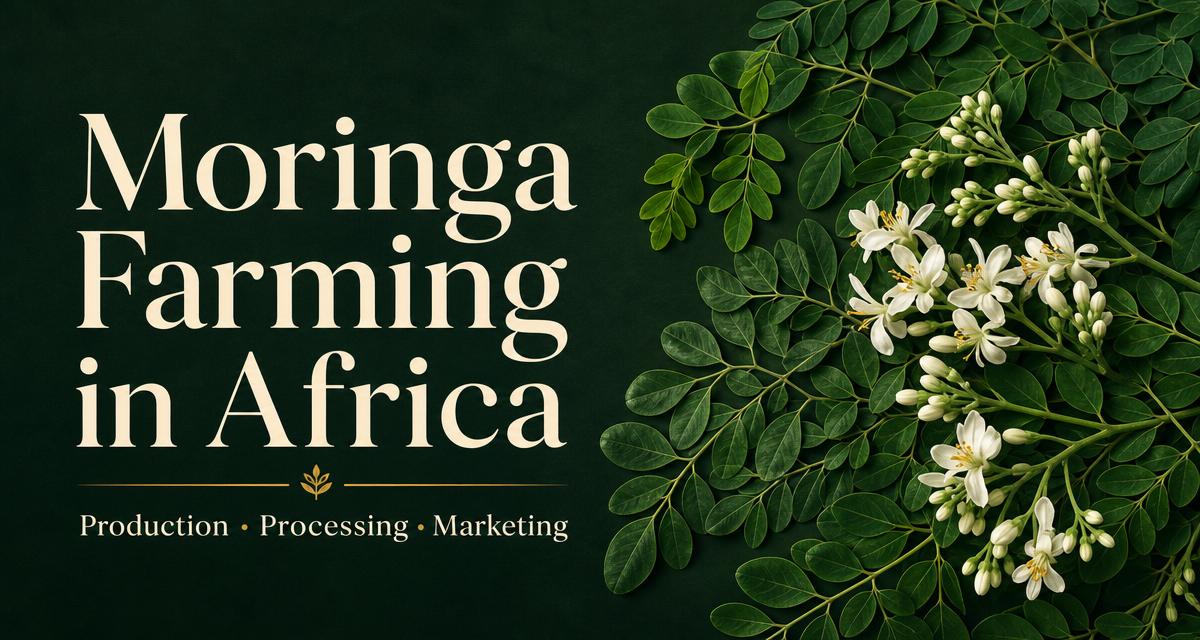
    Moringa grows up to 10 metres tall, with a trunk 20–40 cm in diameter and pale grey-tan bark. Its elongated three-sided pods (10–50 cm long) each hold 12–35 winged brown seeds. Its cream-white flowers are fragrant and abundant — attractive to bees and pollinators.

    Optimal growing conditions: warm tropical climate, well-drained sandy-loam soils, and rainfall of 500–1,500 mm/year. Moringa tolerates drought, marginal soils, and full sun.

    2. Nursery Production

    Direct sowing is usually preferred because moringa's fragile roots don't always survive transplanting. Use a nursery only when direct planting is not possible.

    Setting up the nursery

    Build a shade canopy 2.5 m high with posts and palm leaves that let through ~50% light.
    Fill perforated 25 × 17 cm polybags with ¾ black earth + ¼ coarse sand.
    Arrange bags in rows 10 m long, 1 m apart.

    From seed

    Use fresh, mature seeds (they have no dormancy).
    Soak seeds in water for 48 hours to soften the shell.
    Sow 2–3 seeds per bag, 2 cm deep. Germination takes 5–12 days.
    Thin to the strongest seedling after 14 days.
    Water every other day in dry season; as needed in rainy season.

    From cuttings

    Take hardwood cuttings 2–3 cm diameter, 1–1.5 m long, from branches ≥1 year old.
    Rest cuttings in shade for at least 3 days before planting.
    Plant in 40 × 40 cm bags with the same soil mix; water without wetting the stem.

    3. Field Cultivation Systems

    Choose your system based on your commercial goal:

    Intensive monoculture (leaf production)

    Spacing: 10 × 10 cm or 20 × 20 cm
    Density: up to 1 million plants/ha
    Best for fresh leaf or leaf-powder production at scale.

    Semi-intensive monoculture

    Spacing: 50 cm to 1 m between plants
    Balanced for both leaves and pods.

    Agroforestry / hedgerows

    Spacing: 3–5 m between trees
    Excellent for combining moringa with maize, vegetables, or livestock fodder systems.

    Land preparation: clear, plough, and stake using the classic 3–4–5 triangle for straight rows. Dig planting holes 40 × 40 × 40 cm, mix in compost or well-rotted manure.

    4. Maintaining a Moringa Field

    Hoeing: keep the plot weed-free for the first 3 months.
    Pruning: cut the main stem when the tree reaches ~60 cm to encourage branching. Regular pruning keeps leaves within easy reach and multiplies harvest.
    Mulching: conserves moisture and suppresses weeds.
    Fertilisation: apply compost or manure every 2–3 months. In intensive systems, foliar fertiliser boosts leaf yield dramatically.
    Irrigation: ~6 litres of water per plant per day during dry periods.

    5. Combating Pests and Diseases

    Moringa is naturally hardy, but watch for:

    Pests: termites, caterpillars, aphids, whiteflies, fruit flies.
    Diseases: root rot (from waterlogging), damping-off in nurseries, powdery mildew.

    Prefer integrated pest management: crop rotation, neem-based bio-pesticides, good drainage, and healthy soils. Chemical treatments should only be a last resort.

    6. Harvesting and Post-Harvest

    Leaves

    First harvest: 45–60 days after planting in intensive systems.
    Cut branches, then strip leaves away from the field to avoid contamination.
    Wash lightly and dry immediately.

    Two drying methods

      Shade drying (recommended): preserves the deep-green colour and vitamins. Takes 3–5 days on clean racks in a ventilated room.
      Sun drying: faster but degrades nutrients — avoid direct sun on the leaves.

    Pods and seeds

    Harvest pods when fully mature and brown but before they split.
    Do not climb the tree — branches are fragile. Use a long hooked pole.

    7. Processing Moringa into High-Value Products

    ProductUseValue
    Dried leaf powderFood fortification, supplementsHigh
    Flower powderTea, nutraceuticalsMedium
    Stem & petiole powderLivestock feedLow-Medium
    Bark & root powderTraditional medicineMedium
    Seed powderWater purificationMedium
    Leaf teaBeveragesHigh
    Seed oil (Ben oil)Cosmetics, cooking, lubricantsVery High

    Leaf powder is the entry-level product: grind fully dried leaves, sieve, and pack in airtight, opaque bags. Shelf life: 6–12 months.

    Moringa seed oil is where premium margins live — cold-pressed Ben oil retails at strong prices in cosmetic and health markets.

    8. Marketing Moringa

    Moringa has three main revenue streams:

      Selling seedlings to other farmers, NGOs, and reforestation projects.
      Selling seeds for planting or oil extraction.
      Selling processed products — leaf powder, tea, oil, capsules — with the highest margins.

    Tips for African agripreneurs:

    Certify your product (organic, HACCP) to unlock export markets.
    Brand and package attractively — health-conscious urban buyers pay a premium.
    Sell online, at farmers' markets, and to pharmacies, supermarkets, and cosmetic brands.
    Group into cooperatives to reach volume and negotiate better prices.

    9. Culinary and Medicinal Uses

    Cooking: add fresh young leaves to soups, sauces, stews, and salads. Sprinkle dried powder into porridge, smoothies, bread, or infant meals (1–2 teaspoons/day).
    Moringa pod curry: young pods cooked with onion, garlic, tamarind, and chilli — a beloved recipe from South Asia to West Africa.
    Medicinal infusion: 5 g dried leaves in 1 litre of water for daily wellness tea.
    Childhood malnutrition: adding 1–2 spoonfuls of leaf powder to a child's daily meal delivers protein, iron, calcium, and vitamins A and C.

    Why Moringa Is a Smart Agribusiness Bet

    Fast returns: first leaf harvest within 2 months.
    Low input costs: minimal irrigation, few chemicals.
    Multiple revenue streams: seedlings, seeds, leaves, powder, oil.
    Growing global demand: superfood, cosmetics, water treatment, animal feed.
    Climate resilient: thrives where many other crops fail.

    At Farm to the World, we champion moringa as one of the flagship crops for youth-led agribusiness in Africa — combining nutrition security, environmental restoration, and profitable enterprise.


    Ready to launch your moringa agribusiness?

    Connect with Farm to the World today. Let's cultivate Africa's future—together.

    Get in Touch
    for training, seedlings, and mentorship.

    #Moringa #MoringaFarming #AfricanAgribusiness #TreeOfLife #FarmToTheWorld #SustainableAgriculture #Superfood #AgriTech #YouthInAgriculture #FoodSecurity #Ghana #Africa #Agripreneur #MoringaOleifera #ClimateSmartAgriculture

    Get In Touch

    Ready to partner with us in building a sustainable future for rural Africa? We'd love to hear from you.

    Visit Us

    2A2B, North St
    Achimota, Accra

    Farm to the WorldFarm to the World

    A Resilient Rural Africa Where People And The Environment Thrive. We offer leading research partnerships that facilitate agricultural solutions to hunger, poverty, and natural resources degradation.

    Registered ID: C0065795644

    Focus Areas

    • Sustainable Agriculture
    • Food Security
    • Farmer Training
    • Research Partnerships
    • Community Development

    © 2024 Farm to the World. All rights reserved. Building a sustainable future for rural Africa.